
Hydraulic Breaker Terms: A Glossary of 30 Spec Sheet Words
A glossary of 30 hydraulic breaker terms, from accumulator to working window, with LICH model figures as examples and a link to the guide for each part.
All buyer guides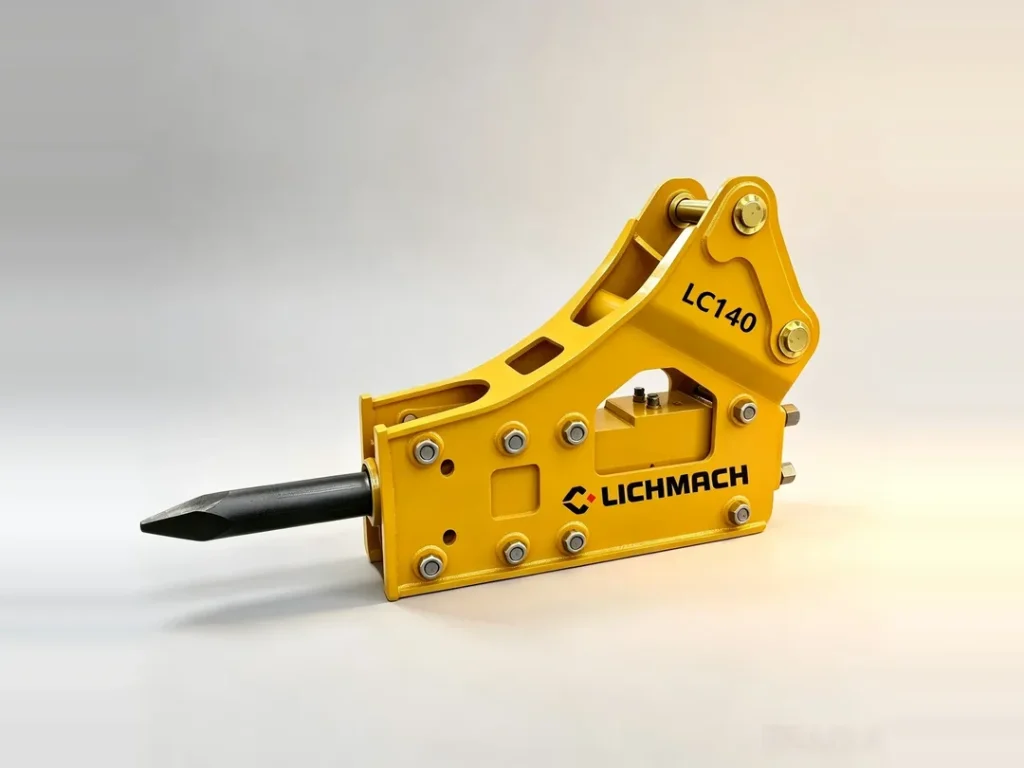
Hydraulic breaker terms can turn a specification sheet into a puzzle: BPM, back head, blank firing, working window. This glossary explains 30 hydraulic breaker terms in plain words, in alphabetical order. Where a term has a number behind it, the example comes from the LICH model range, and where a term has its own guide, the link is in the entry.
Hydraulic breaker terms on one specification line
Most of them meet in one line of a model chart. Here is the line for the LC-140, with the term for each figure.
| Figure | Term | What it tells you |
|---|---|---|
| 20–25 t | Excavator class | Which carriers the model is built for |
| 140 mm | Chisel diameter | The size of the tool, and the number in the model name |
| 1,977 kg | Weight | What the arm has to hold |
| 120–180 L/min | Oil flow | What the auxiliary circuit has to deliver |
| 160–220 bar | Working pressure | The pressure at the breaker during work |
| 350–450 BPM | Impact rate | How many blows it delivers each minute |
| 6,485 J | Impact energy | How hard each blow is |
Figures from the LICH model specifications, read on 13 November 2026. Every model is listed on the specifications chart.
Hydraulic breaker terms A to Z
Accumulator
A gas-charged chamber on some breakers that stores oil under pressure and smooths the pressure peaks of each blow. See the accumulator and diaphragm guide.
Auxiliary circuit
The extra hydraulic line on an excavator that feeds an attachment. Its oil flow and pressure have to match the window of the breaker.
Back head
The top section of the breaker, which holds the nitrogen charge above the piston. See the back head guide.
Back pressure
Pressure in the return line from the breaker to the tank. High back pressure slows the piston.
Blank firing
Blows delivered with no material under the tool. The energy goes back into the breaker.
Body type
The housing around the working parts. LICH lists silent (box), top (tower), side (triangular) and concentric bodies. See box type vs side type vs top type.
BPM
Blows per minute, also called impact rate. It runs from 90–130 BPM on the LC-230 to 600–1,100 BPM on the LC-40. See the impact rate chart.
Bracket
The adapter that pins the breaker to the excavator arm. It is made to the pin diameter and arm width of the carrier.
Bushing
A wear sleeve in the front head that guides the tool. Most breakers have an upper and a lower one. See the bushing wear guide.
Carrier
The machine that carries the breaker: an excavator, backhoe loader or skid steer. LICH models cover carriers from 1 t to 80 t.
Chisel
The steel working tool, also called the tool or bit. Its diameter names the model: the LC-140 has a 140 mm chisel. See bits and chisels.
Cylinder
The middle section of the breaker, in which the piston moves.
Diaphragm
The rubber membrane that separates gas from oil inside the accumulator.
Excavator class
The carrier weight range a model is built for, such as 20–25 t for the LC-135.
Front head
The lower section that holds the tool, the bushings and the retainer pins. See the front head guide.
Impact energy
The work done by one blow, in joules. It runs from 204 J on the LC-40 to 49,800 J on the LC-230. See the impact energy guide.
Moil point
A tool with a conical tip, used for general breaking. See the moil point guide.
Nitrogen charge
The gas pressure in the back head that drives the piston down and adds to the blow. See the nitrogen pressure guide.
Oil flow
The oil the breaker needs each minute: 15–30 L/min on the LC-40 and 330–430 L/min on the LC-230. See the flow rate chart.
Piston
The steel hammer inside the cylinder that strikes the top of the tool. See the piston guide.
Relief pressure
The pressure at which the relief valve on the carrier opens. It is set above the working pressure of the breaker.
Retainer pin
A pin that holds the tool in the front head while letting it slide. See the pin guide.
Seal kit
The set of seals for one exact model. See the seal kit guide.
Silent type
A box body that encloses the working parts to lower noise. See silent hydraulic breaker.
Through bolts
Long bolts that clamp the back head, cylinder and front head together. See the through bolts guide.
Valve
The control valve that reverses the oil on the piston each cycle. See the valve guide.
Wear limit
The dimension at which a part has to be replaced. It is given in the manual for the exact model.
Weight
The mass of the breaker, from 79 kg on the LC-40 to 8,909 kg on the LC-230. See the weight chart.
Working pressure
The oil pressure at the breaker during work: 90–120 bar on the LC-40 and 260–300 bar on the LC-230.
Working window
The range of oil flow and pressure inside which a model runs correctly.
Questions about hydraulic breaker terms
Is a hydraulic breaker the same as a hydraulic hammer?
Yes. The two hydraulic breaker terms name one tool, and rock breaker is a third. See hydraulic breaker vs hydraulic hammer.
Which hydraulic breaker terms matter most when matching a breaker to an excavator?
Excavator class, oil flow and working pressure. Weight, impact rate and impact energy then separate the models that fit. The matching guide walks through the checks.
What do the numbers in a LICH model name mean?
The chisel diameter in millimetres. The LC-68 has a 68 mm chisel and the LC-200 a 200 mm chisel.
Keep Comparing
Compare more breaker models and buyer guides related to this topic.


