
Hydraulic Breaker Impact Energy: What the Joules Mean
What hydraulic breaker impact energy measures, how it scales from 204 J to 29,700 J across LICH models, and how to keep the rated energy on site.
All buyer guides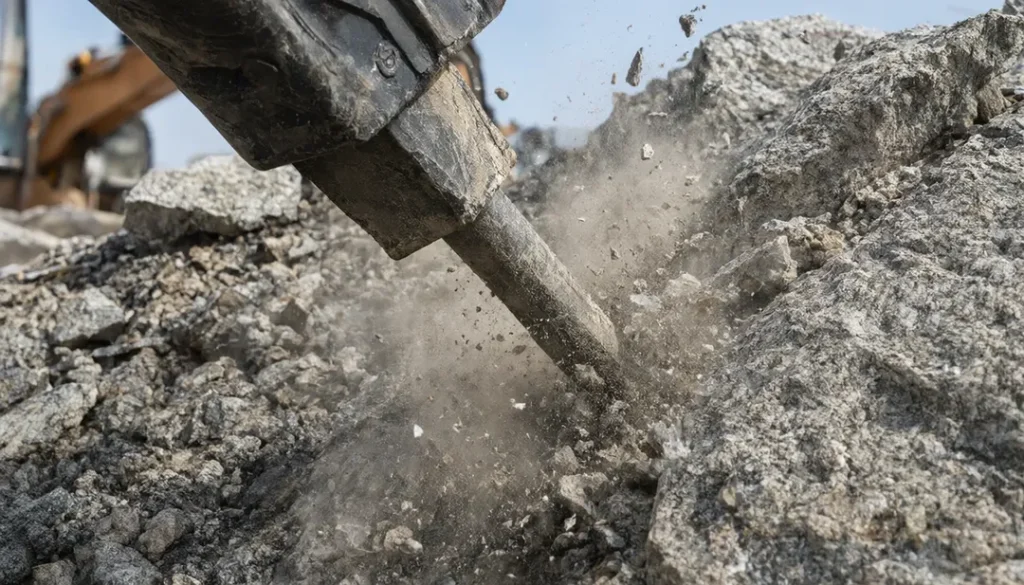
Hydraulic breaker impact energy is the work done by one blow of the piston on the chisel, measured in joules (J). It is the figure that tells you how hard a breaker hits, and with the impact rate it decides how fast the breaker gets through rock or concrete. This guide explains what hydraulic breaker impact energy means, how it scales across the 18 LICH hydraulic breaker models, whose listed figures run from 204 J to 29,700 J, and how to use it when choosing a size.
What impact energy measures
Inside a breaker, oil drives the piston up and nitrogen pressure helps drive it down. When the piston strikes the top of the chisel, its moving energy passes into the tool and then into the material. Hydraulic breaker impact energy is that energy per blow. Two things raise it: a heavier piston, and a faster piston at the moment of impact. That is why impact energy grows with breaker size, and why low nitrogen pressure or low oil flow cuts it. The how a hydraulic breaker works guide shows the cycle step by step.
Hydraulic breaker impact energy by LICH model
| Model | Excavator class | Breaker weight | Impact energy | Impact rate | Energy per kg of breaker |
|---|---|---|---|---|---|
| LC-40 | 1–1.5 t | 79 kg | 204 J | 600–1,100 bpm | 2.6 J/kg |
| LC-53 | 3–5 t | 166 kg | 406 J | 600–1,100 bpm | 2.4 J/kg |
| LC-75 | 7 t | 410 kg | 1,835 J | 450–980 bpm | 4.5 J/kg |
| LC-100 | 12 t | 841 kg | 3,102 J | 350–700 bpm | 3.7 J/kg |
| LC-140 | 20–25 t | 1,977 kg | 6,485 J | 350–450 bpm | 3.3 J/kg |
| LC-155 | 25–30 t | 2,739 kg | 10,930 J | 200–300 bpm | 4.0 J/kg |
| LC-175 | 36–40 t | 3,757 kg | 15,500 J | 120–200 bpm | 4.1 J/kg |
| LC-200 | 45–55 t | 6,388 kg | 29,700 J | 100–140 bpm | 4.6 J/kg |
Impact energy, rate and weight from the LICH model specifications, read on 20 October 2026; energy per kg is our own calculation from those figures. All 18 models are in the hydraulic breaker specifications chart.
Three patterns in the numbers
- Energy rises faster than weight at the top. The LC-200 weighs about 81 times as much as the LC-40 but delivers about 146 times the hydraulic breaker impact energy. The largest models give 4.6 J per kilogram of breaker against 2.4–2.6 J/kg for the smallest, which is why they suit hard rock.
- Energy and rate trade off. Small breakers hit lightly but fast, up to 1,100 blows per minute; the LC-200 hits 29,700 J at 100–140 blows per minute. Light, fast blows suit thin concrete and trenching; heavy, slow blows split hard rock.
- Steps are not equal. Going from the LC-53 to the LC-75 multiplies impact energy by 4.5; going from the LC-150 to the LC-155 adds 17%. When the circuit allows, a one-size step at the small end changes far more than a step at the large end.
How much hydraulic breaker impact energy do you need?
The carrier sets the limit first: the breaker must match the excavator’s weight, oil flow and pressure. Inside that limit, pick by material:
- Asphalt, thin slabs, brick: lower energy with a high impact rate.
- Reinforced concrete and foundations: medium energy; the hydraulic concrete breaker guide covers sizing.
- Hard rock, granite and basalt: the highest hydraulic breaker impact energy the carrier can run. See the hydraulic breaker for quarry guide.
Keeping the rated energy on site
A breaker only delivers its listed hydraulic breaker impact energy when it is set up correctly:
- Oil flow and pressure inside the listed range. Low flow slows the piston and weakens each blow.
- Correct nitrogen charge. A low charge is one of the most common reasons a breaker feels weak; follow the nitrogen pressure guide.
- Bushings within wear limits. A loose tool absorbs part of each blow; see the bushing wear guide.
- Down pressure on the tool. The operator must hold the chisel firmly against the material; never fire the breaker without contact.
Questions buyers ask
Is more impact energy always better?
No. A breaker that is too large for the carrier runs slowly, overloads the arm and heats the oil. Pick the highest energy that fits the carrier’s circuit and weight.
Is impact energy the same as power?
No. Hydraulic breaker impact energy is per blow, in joules. Power also depends on how many blows per minute the breaker delivers.
Can I compare impact energy between brands?
Compare figures from the same catalogue and the same conditions where you can, and check them together with weight, oil flow and impact rate. Our matching guide walks through all four.
Send us your excavator model, breaker-circuit flow and pressure, and the material you break. We will recommend the LICH model with the right hydraulic breaker impact energy for your machine.
Keep Comparing
Compare more breaker models and buyer guides related to this topic.


