
How to Choose a Hydraulic Breaker Supplier
Learn how to choose a hydraulic breaker supplier using evidence for identity, model matching, machining, testing, parts, OEM, export and after-sales support.
All buyer guides
How to Choose a Hydraulic Breaker Supplier Using Evidence
How to choose a hydraulic breaker supplier starts with evidence, not factory superlatives. A supplier should be able to turn a buyer’s carrier, application and delivery requirements into a traceable technical and commercial record. A factory video, low price or long product list can support the review, but none proves model matching, process control, parts traceability or export execution on its own.
This checklist is designed for buyers, dealers and fleets comparing suppliers before a sample order or factory visit. It separates documents to verify remotely, processes to observe on site and records to keep with the final order.
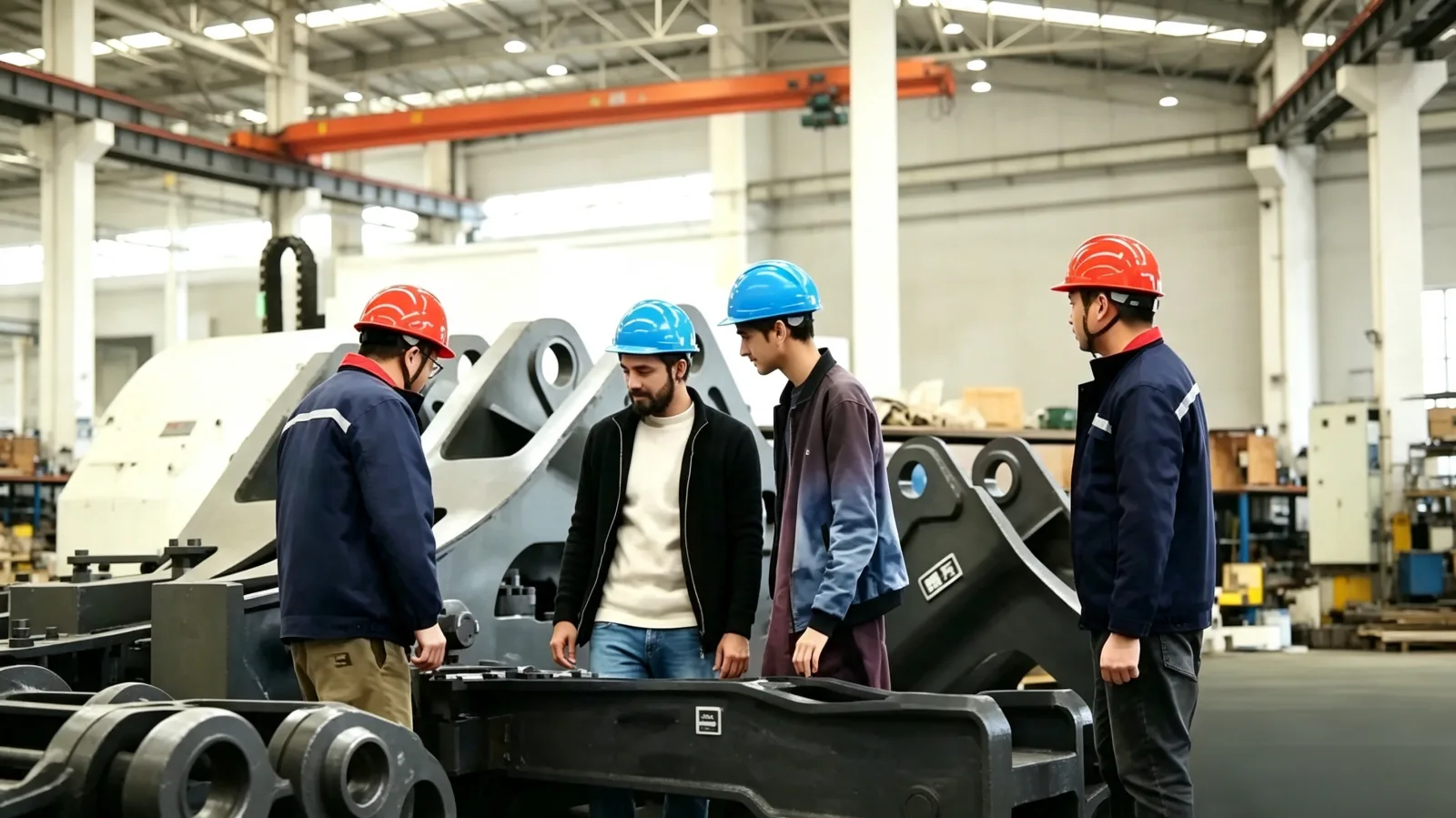
The Eight-Gate Supplier Audit
| Gate | Evidence | Failure signal |
|---|---|---|
| Business identity | Legal entity, address, contacts and bank-beneficiary match | Conflicting names or unexplained payment route |
| Technical selection | Carrier and hydraulic inputs tied to a public LC model | Model selected from tonnage or photo alone |
| Manufacturing control | Process route, drawings, inspection and revision records | Only finished-product photos |
| Assembly and test | Model-linked checks, test record and nonconformance handling | One demonstration with no traceability |
| Parts support | Model, serial and drawing-based parts identification | Generic kits without matching evidence |
| OEM control | Artwork, color, nameplate and packing approvals | Logo promise with no controlled files |
| Export execution | Quote scope, packing, documents, trade term and named point | One total price with hidden exclusions |
| After-sales workflow | Required evidence, response route and warranty boundary | “Any problem will be solved” without a process |
Gate 1: Verify the Supplier’s Business Identity
Record the legal company name, registered or operating address, website domain, business email, quotation issuer, contract party, invoice party and bank beneficiary. Ask the supplier to explain any difference before payment.
Do not use a messaging account, marketplace profile or website footer as the only identity evidence. Keep the verified documents with the order and confirm bank-detail changes through an independent known contact.
Gate 2: Test the Technical Selection Process
Send a realistic inquiry with carrier brand and model, operating weight, auxiliary oil flow, working pressure, relief setting, coupler information, application and site conditions. A disciplined supplier should identify missing fields rather than immediately declaring one breaker model.
LICHI public model names follow chisel diameter, such as LC-68 and LC-140. The supplier should still record the body type, complete attachment weight, hydraulic range and mounting basis. Use the breaker matching guide to evaluate the response.
Gate 3: Trace One Model Through Manufacturing
Do not accept a tour that jumps from raw steel to finished yellow breakers without showing the control points. Select one public model and ask how its drawing revision, material, machining, cleaning, assembly, test and packing records are connected.
Evidence to review
- controlled drawing or specification reference;
- incoming material or component identification appropriate to the part;
- machining inspection method and recorded result;
- cleaning and contamination-control route before assembly;
- assembly traveler, responsible station or equivalent trace;
- test record linked to the model or unit;
- nonconformance and rework approval process;
- packing and dispatch record.
The exact form can differ between factories. The audit question is whether a result can be traced to a controlled requirement and responsible process.
Gate 4: Review Machining and Measurement Control
CNC machines are capacity evidence, not automatic quality proof. Ask which dimensions are critical for the selected component, how instruments are selected, how calibration status is controlled and what happens when a measurement is outside the requirement.
Observe whether parts are protected from mixing, damage and contamination between operations. A clean presentation area does not prove shop-floor control; follow a normal production route where permitted.
Gate 5: Review Cleaning, Assembly and Pressure-Test Records
Hydraulic components depend on cleanliness and correct assembly. Ask how cleaned parts are protected, how seals and matched components are identified, how assembly errors are prevented and how tools or fixtures are controlled.
For testing, request the test purpose, required inputs, result fields, unit or batch linkage and action for a failed result. A video of one breaker operating is useful media but is not a complete test system.
Gate 6: Challenge Spare-Parts Identification
Give the supplier a realistic parts request with model, serial or nameplate evidence, photos and service scope. The response should distinguish confirmed items from information still required.
Seal kits, pistons, bushings, hoses, retainers and tools should be tied to the exact breaker evidence. A parts photograph or similar diameter is not enough. Review the LICHI spare-parts directory and parts identification diagram for the required record.
Gate 7: Audit OEM and Nameplate Change Control
Ask how the supplier controls paint color, logo artwork, decal position, nameplate fields, document language and packing marks. Every customer-supplied file should have a version and approval status.
Test a change scenario: if the buyer changes the logo or carrier after approval, which documents are revised, who approves the change, and how is production prevented from using the old version? A reliable answer should include a record, not only a promise.
Gate 8: Normalize the Export Quotation
The quotation should state public LC model, body type, chisel diameter, bracket basis, hoses, fittings, tools, spare parts, OEM scope, packing, currency, payment, validity, lead-time basis and trade term with a named place or port.
Compare suppliers on the same scope. Use the price-normalization guide and export RFQ checklist. Do not infer missing items from a low total.
Audit the After-Sales Workflow Before You Need It
Ask the supplier to show the information required for a technical case: model, serial, carrier, settings, photos, video, measurements, service history and operating conditions. Confirm who receives the case, how the response is recorded and what evidence is required before parts are recommended.
Review the warranty boundary, exclusions for normal wear and operating damage, transport responsibility and approval needed before disassembly or replacement. A clear process protects both buyer and supplier from unsupported conclusions.
Remote Audit Before a Factory Visit
- Verify legal identity and contact consistency.
- Send a complete technical inquiry and evaluate missing-data questions.
- Request one model-specific quotation and drawing sample with sensitive values redacted if needed.
- Ask for live video through the normal production route, not only selected promotional clips.
- Review a redacted test record, packing list and parts-identification example.
- Agree on the on-site agenda and evidence list before travel.
A remote review cannot prove every factory condition, but it can expose missing processes and make an on-site visit more efficient.
On-Site Factory Visit Route
| Stop | What to observe | Record |
|---|---|---|
| Order review | How carrier and configuration data becomes a controlled order | Selection and approval fields |
| Material / parts receipt | Identification, protection and status control | Sample trace reference |
| Machining | Drawing revision, measurement and nonconformance route | One controlled measurement example |
| Cleaning / assembly | Contamination prevention and part identity | Assembly route and responsibility |
| Testing | Inputs, outputs, unit linkage and failed-test action | Redacted test record |
| Finished stock | Model status, protection and mix-up prevention | Identification method |
| Packing | Accessories, labels, protection and shipping marks | Packing checklist |
| Support | Parts and technical-case workflow | Sample response route |
Sample-Order Acceptance Plan
A factory audit reduces uncertainty but does not replace order acceptance. For the first order, define the carrier and technical match, approved drawings, OEM files, packing, documents, pre-dispatch evidence and arrival checks.
- Freeze the public LC model, body type and chisel diameter.
- Approve the bracket or coupler drawing and hose schedule.
- Approve logo, nameplate, labels and packing marks.
- Specify required production and test records.
- Define photo or video evidence before packing.
- Check package count, visible damage and identity on arrival.
- Commission on the approved carrier and keep the final settings record.
Supplier Audit Red Flags
- The supplier will not state the legal contract or payment entity.
- A final model is promised before hydraulic or mounting data is collected.
- Product names change between the quote, drawing and nameplate.
- Finished-product photos are offered instead of process and record evidence.
- Test claims have no unit, batch or model linkage.
- Spare parts are identified from appearance alone.
- OEM changes are managed only through chat messages.
- The trade term lacks a named place or port.
- Warranty language promises outcomes without stating evidence and exclusions.
Score the Evidence Without Hiding Critical Failures
A numerical score can help compare several suppliers, but do not average away a critical failure. Treat business identity, technical match, safety-critical process control and payment consistency as pass/fail gates. Score convenience items only after those gates pass.
Keep each score linked to a document, observation, date and reviewer. “Good factory” is not an auditable conclusion. “Test record linked to the selected LC model was reviewed on this date” is.
Re-Audit Triggers After Approval
Supplier approval should not be permanent. Repeat the relevant review when the legal or bank entity changes, production moves, a new breaker family is introduced, repeated nonconformities occur, traceability fails, or the supplier changes a critical process without notice.
The re-audit can be narrow when the change is narrow. A new packing supplier may require a packing review; a new power-cell production site requires a deeper process audit. Record the trigger, scope, evidence and approval decision.
Keep a Supplier Evidence File
- verified legal, contact and payment identity;
- audit date, people, locations and scope;
- model-specific selection and process samples;
- redacted inspection, test and nonconformance records;
- parts-identification and after-sales examples;
- sample-order approvals, arrival findings and corrective actions;
- open risks, responsible owner and next review date.
This evidence file makes the next purchase faster and prevents a buyer from repeating the full audit while forgetting unresolved risks.
Assign an owner to each open item and a due date. A supplier remains conditionally approved while a critical record is missing; a high average score should not hide that condition. Review actual order and warranty performance at the next audit instead of relying only on the original factory presentation.
Reference Boundary
ISO 9001 describes a quality-management framework based on controlled processes, evidence and improvement, but a certificate alone does not prove a particular breaker or order. Manufacturer technical data also treats carrier class, flow, pressure and tool size as separate selection fields. Verify the actual supplier process and order records.
- ISO overview of ISO 9001 quality management systems
- Epiroc hydraulic breaker technical-data brochure
Frequently Asked Questions
Is an ISO 9001 certificate enough to approve a breaker supplier?
No. Verify its scope and validity, then inspect the actual technical, production, test, parts and export records for the order.
Can I audit a factory remotely?
You can verify identity, selection discipline and sample records remotely. High-risk orders may still require an on-site visit or independent inspection.
What should I ask during a factory video call?
Follow one selected model through normal material, machining, cleaning, assembly, test, finished-stock and packing stages.
Why audit spare-parts support before ordering?
It shows whether future seal kits, pistons, bushings, hoses and tools can be matched from traceable model evidence.
Should the lowest-price supplier fail automatically?
No. Normalize the technical and delivery scope, then judge whether the evidence, exclusions and total risk support the lower price.
Keep Comparing
Compare more breaker models and buyer guides related to this topic.


