
Hydraulic Breaker Through Bolts: Inspection and Ordering Guide
Identify hydraulic breaker through bolts, record threads and failure evidence, compare set contents and request model-matched replacement fasteners.
All buyer guides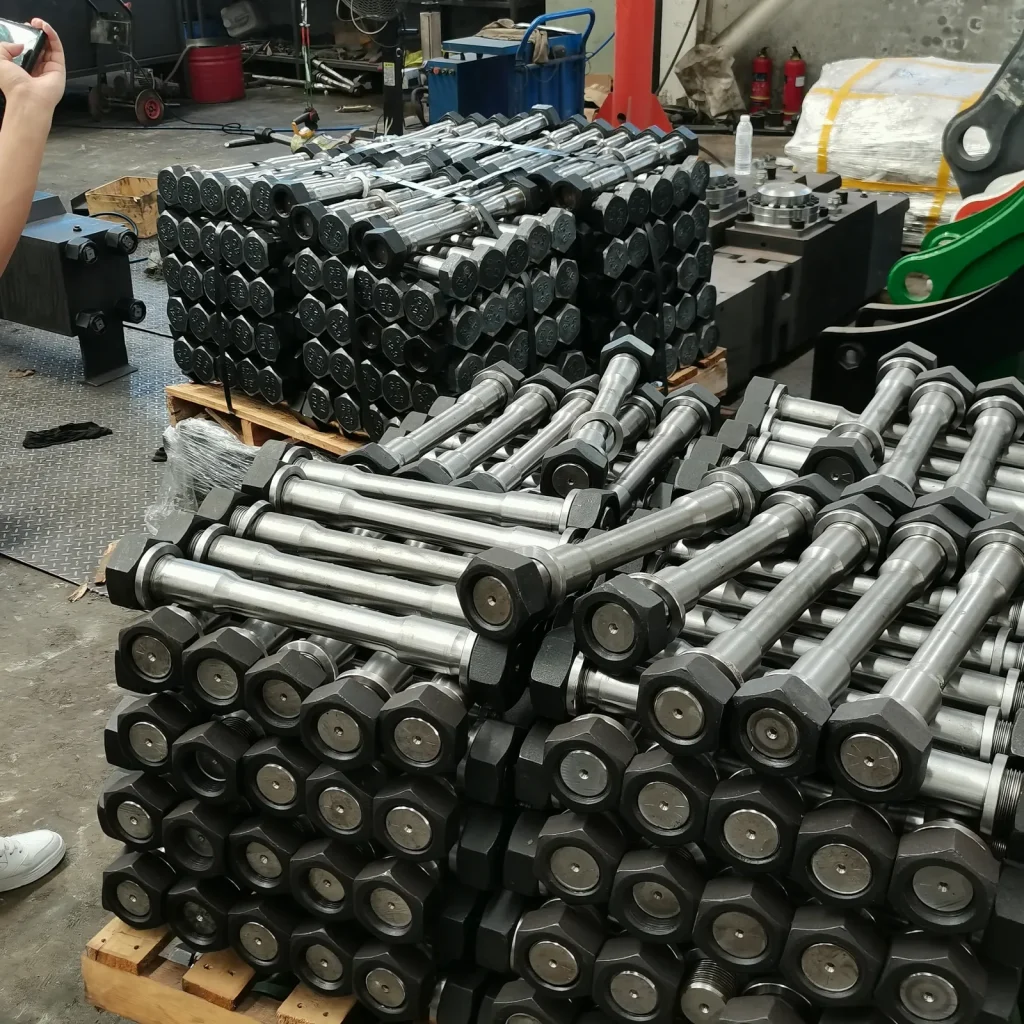
Hydraulic breaker through bolts—also called tie rods, side rods or body bolts in some parts lists—clamp major power-cell sections into one aligned assembly. They operate under repeated impact and must match the exact breaker design. Length, thread, shoulder geometry, nut, washer, material specification and tightening procedure are not universal.
This guide explains how to identify through bolts, preserve failure evidence and request the correct set. It does not provide torque values, tightening sequences, reuse criteria or repair instructions. Installing or tensioning breaker fasteners is controlled work that must follow the current manual for the exact model.
Safety boundary: Through bolts clamp heavy components that may contain stored hydraulic or gas pressure. Do not loosen, heat, weld, straighten or tension them while the breaker is pressurized, suspended or unsupported. Isolate and depressurize the breaker by the approved procedure and use trained personnel with calibrated tools.
What Hydraulic Breaker Through Bolts Do
A common power-cell layout uses long fasteners to hold the back head, cylinder and front head together. Correct clamping helps maintain contact between mating faces and preserves the alignment intended by the manufacturer. The bolt set works with nuts, washers, threads, locating features and component faces; it should not be treated as four unrelated pieces of steel.
Some designs use different fastener arrangements or terminology. Confirm the item on the exact hydraulic breaker parts drawing before ordering. Housing or bracket bolts are not automatically the same as power-cell through bolts.
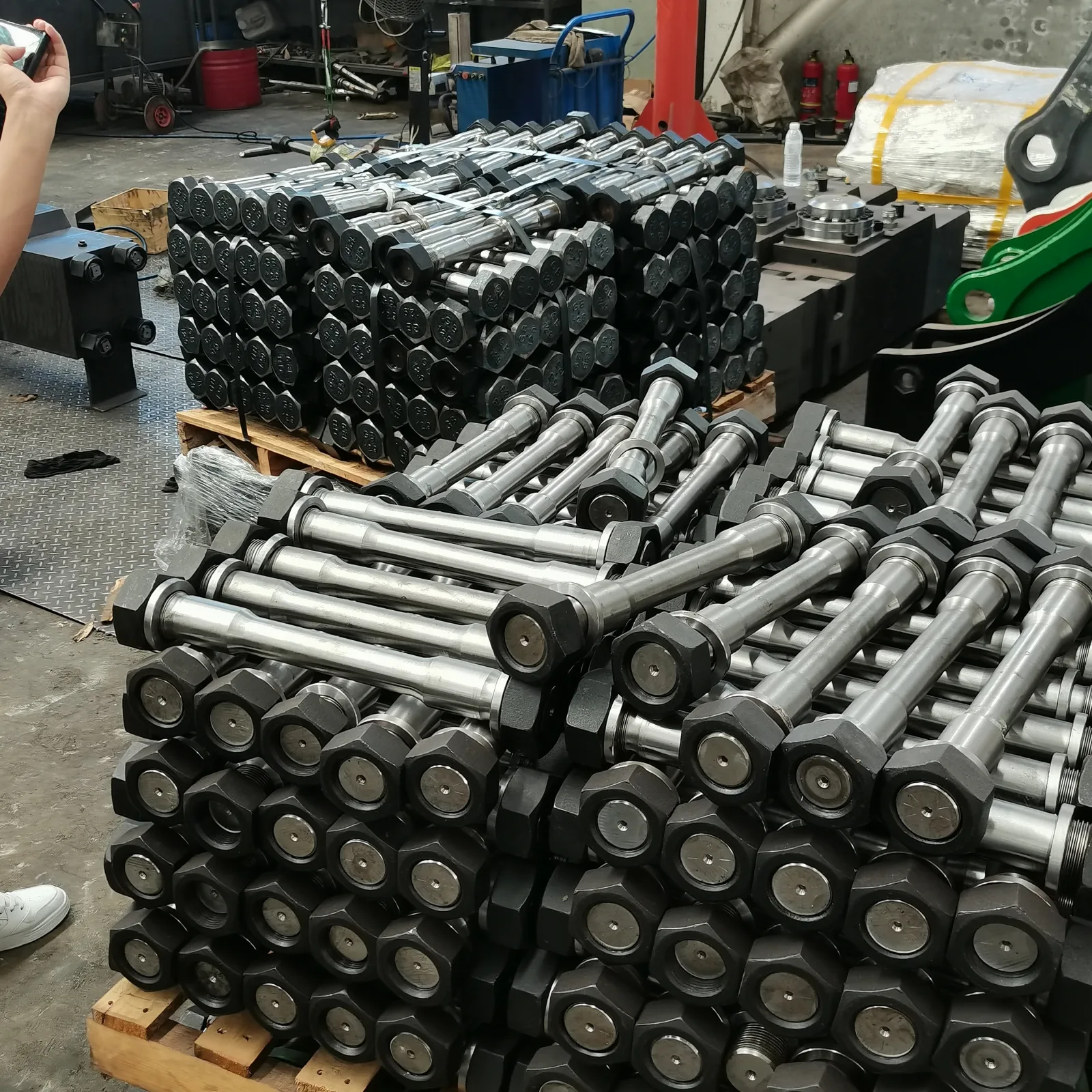
Through Bolts Are Not Generic Hardware
A correct bolt may include changes in shank diameter, reduced section, shoulder location, thread form, thread length, end shape, head or nut design and surface treatment. The matched tightening method can depend on the design. Replacing one with a visually similar standard fastener can change load distribution and fatigue behavior.
Never infer grade or material from color, weight or head appearance. Request the controlled supplier specification and agreed inspection evidence. If the old bolt has failed, preserve both pieces and the related nut rather than discarding the fracture surface.
Identification Pack for a Through-Bolt Inquiry
| Item | What to provide | Why it matters |
|---|---|---|
| Breaker identity | Nameplate, full model, serial/revision and complete photographs. | Connects the fastener to the correct power-cell drawing. |
| Drawing reference | Item number, part number and quantity per assembly. | Separates through bolts from housing or bracket fasteners. |
| Overall geometry | Labeled overall length, shank sections and shoulder positions. | Controls engagement and clamped-stack fit. |
| Thread details | Diameter, pitch, threaded length, hand and matching nut. | A near match can damage threads or produce incorrect engagement. |
| Failure evidence | Both ends, fracture, bending, corrosion, nut and mating-area photographs. | Helps determine whether the request should include related inspection. |
When Hydraulic Breaker Through Bolts Need Inspection
Inspect according to the model’s maintenance schedule and after an unusual event such as a loosened power cell, visible relative movement, fluid leakage at a body joint, broken fastener, severe side loading, major tool failure or disassembly. A surface mark is not automatically a reject condition, but a suspected crack, permanent deformation or damaged thread requires qualified review.
Do not keep operating to “see if it gets worse.” Movement between clamped sections can affect contact faces, seals, locating features and other fasteners. Record the breaker position, operating complaint and visible joint condition before dismantling changes the evidence.
Failure Evidence to Record
Fracture location and surface
Photograph the entire bolt, then the fracture at high resolution under neutral light. Mark which position it occupied. Do not grind, weld or aggressively clean the surface before technical review. The fracture alone may not reveal the complete cause, but damaged evidence makes review harder.
Permanent stretch, necking or bending
Compare only against a controlled drawing or an unused verified part. A worn or previously loaded bolt should not be used as the nominal reference. Record the instrument, measurement points and orientation.
Thread and nut condition
Document pulled threads, galling, corrosion, impact marks and the amount of engagement. Keep each nut tied to its original bolt and location. A new bolt with damaged or mismatched mating hardware does not restore the designed joint.
Contact faces and neighboring bolts
Check the back head, cylinder and front head mating areas for fretting, gaps, debris or deformation. Inspect the full bolt set rather than replacing only the visibly failed member without review.
Why Hydraulic Breaker Through Bolts May Be Quoted as a Set
A supplier may recommend a complete matched set when service history, loading or revision consistency cannot be established. That is not a universal rule: the exact manual and inspection determine the correct scope. Ask the quotation to explain whether bolts, nuts, washers and any related seals are included.
Keep used positions labeled if the workshop removes a set for inspection. Mixing locations erases evidence of load distribution and joint movement. If one fastener differs in mark, length or thread, stop and confirm whether the assembly already contains mixed revisions.
Measurement Without Guessing
Use a marked drawing. Typical records include overall length, unthreaded and reduced-shank diameters, shoulder locations, thread diameter and pitch, threaded length, end features and matching nut dimensions. State whether a value was measured from a new part, used part or damaged fragment.
Do not substitute a rounded ruler reading for a thread gauge or drawing. Do not use a stated strength grade from a marketplace listing as proof. The supplier should confirm fitment and specification in writing before production or dispatch.
Installation Information Belongs to the Exact Manual
Tightening method, sequence, staged values, lubrication condition, nut orientation, reuse rules and follow-up inspection can differ. A generic torque copied from another model is unsafe and can produce either insufficient clamping or fastener overload. Calibrated equipment does not correct the use of the wrong value.
Record the manual revision, tool identification, calibration status, personnel and final inspection as part of the service job. If the approved procedure is unavailable, do not improvise; request it from the breaker supplier or qualified service provider.
Related Components to Inspect
Review nuts, washers, mating threads, locating parts, back head, cylinder, piston/cylinder evidence, front head and any joint seals affected by movement. If oil or gas leakage is reported, preserve the leak location before cleaning and follow the pressure-safety procedure.
Also inspect the external housing and bracket separately. Housing fasteners can create movement that looks similar from a distance but belongs to a different assembly and tightening specification.
How to Compare Quotations for Hydraulic Breaker Through Bolts
| Quotation line | Evidence required | Buyer check |
|---|---|---|
| Model/revision | Exact breaker and drawing reference. | Does it match the serial or supplied measurement pack? |
| Set quantity | Bolts per breaker and quantity of sets. | Are spares and installed-set quantities separated? |
| Included hardware | Itemized nuts, washers and related components. | Is the quotation a bolt only or a complete set? |
| Specification | Agreed material/process and inspection documents. | What traceability is supplied with the batch? |
| Packing | Thread protection, corrosion protection and package weight. | Will marked sets remain separated in transit? |
Handling, Storage and Shipping
Protect threads and precision surfaces from impact, dirt and corrosion. Keep each bolt set and matching hardware identified by model and batch. Long fasteners must be restrained so they do not bend under their own weight or move inside a crate.
For export, confirm the actual net and packed weight, package dimensions, preservation method and labeling. Photograph the protected threads, model labels and closed package before dispatch. Availability, packing and lead time must be confirmed for the order rather than copied from an earlier shipment.
Common Through-Bolt Mistakes
- Using a standard bolt because the thread appears to fit.
- Ordering one piece when the service decision requires a matched set.
- Reusing damaged nuts or mixing hardware from different revisions.
- Copying torque values from a similar breaker or an online forum.
- Discarding fracture evidence before the related components are inspected.
- Confusing power-cell through bolts with bracket or housing bolts.
Copy-and-Send Through-Bolt Inquiry
Hydraulic breaker through-bolt inquiry
Breaker brand / full model / serial: ___
Drawing item / existing part number: ___
Quantity per breaker / number of sets: ___
Overall length and labeled geometry: ___
Thread diameter / pitch / threaded length: ___
Matching nut and washer photographs: attached / unavailable
Reason for replacement and original positions: ___
Fracture or damage photographs: attached / not applicable
Quantity and destination: ___
Please confirm fitment, full set contents, specification evidence, packing and lead time.
Frequently Asked Questions
Are through bolts the same as side bolts?
Terminology varies. Confirm the item location and part number on the exact drawing instead of relying on the name alone.
Can I replace only one broken through bolt?
The exact manual, service history and inspection decide the scope. Have the complete set and mating assembly reviewed before ordering.
Can a bent bolt be straightened?
Do not improvise a repair. Permanent deformation requires review against the manufacturer’s criteria, and heating or straightening can change properties.
Is the torque based only on bolt diameter?
No. Joint design, fastener specification, thread condition, lubrication state and procedure matter. Use only the exact approved value and sequence.
What proves that a replacement bolt fits?
The breaker identity, drawing reference, controlled geometry, matching hardware and written supplier confirmation together provide the fitment basis.
Technical References
NPK’s official GH-series hydraulic hammer operator manual separates bracket-bolt and hydraulic-hammer service information by model range. Epiroc’s official parts information similarly lists fasteners and bolt kits against specific breaker models. These sources support the exact-model rule; they do not provide LICHI through-bolt specifications or tightening values.
Request a Model-Matched Through-Bolt Set
Send the breaker identity, drawing reference, labeled measurements and damage record through LICHI contact or the spare-parts support page. LICHI will confirm the quoted model, set contents, inspection documents, availability, price, packing and lead time in writing.
Keep Comparing
Compare more breaker models and buyer guides related to this topic.


