
Box Type vs Side Type vs Top Type Hydraulic Breaker
Box type, side type, top type or concentric? Compare hydraulic breaker bodies by noise, mounting, service and weight, with the LICH models available in each.
All buyer guides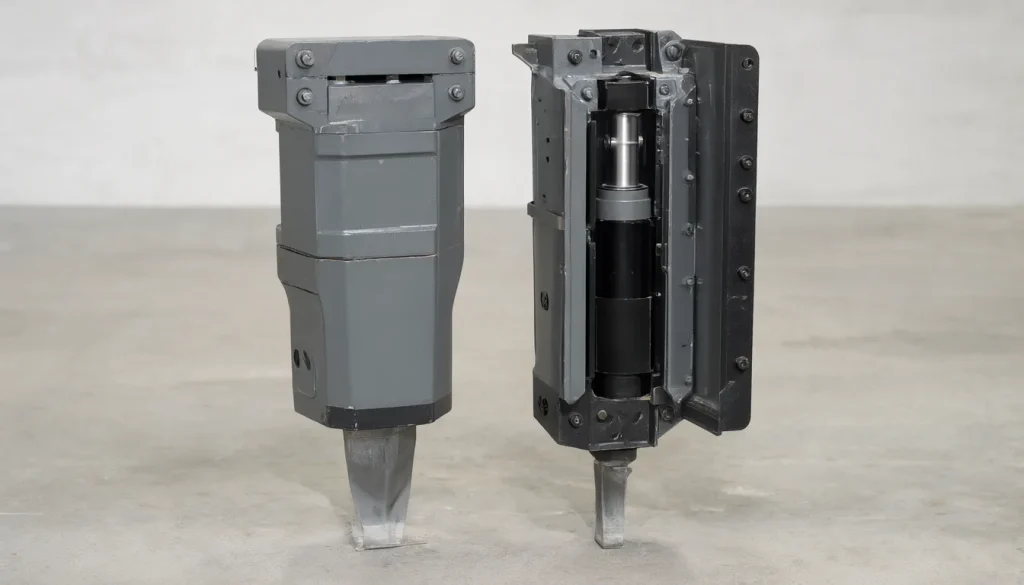
Every hydraulic breaker has the same power cell inside: a piston, a control valve and a nitrogen chamber driving a chisel. What changes between a box type, a side type and a top type hydraulic breaker is the housing around that power cell and the way it mounts to the excavator. Choosing a box type hydraulic breaker or an open body decides how much noise and dust escape, how the breaker sits on the arm, and how easy it is to service. This guide compares the four bodies LICH builds, using which of our 18 models come in each one.
The four body types
- Box type hydraulic breaker (silent): the power cell sits inside a closed steel box. The enclosure cuts noise and dust and shields the cylinder from knocks. LICH builds its box type hydraulic breaker as the silent (box) body.
- Side type (triangular): an open body with side plates bolted to either side of the power cell and the mounting bracket on the back. It is compact and light, and it is easy to strip for service. LICH calls it the triangular side-mounted body.
- Top type (tower): an open body with the bracket on top, so the breaker hangs in line with the arm like a bucket. The guided piston layout suits long runs of rock breaking. LICH builds it as the tower (top-mounted) body.
- Concentric (solid body): a compact solid-body build with its own dimensions and weight. LICH offers it on seven models, listed below.
Which LICH models come in which body
| Body type | Models available | Count |
|---|---|---|
| Box type hydraulic breaker (silent) | LC-35 to LC-230, except LC-200F | 17 |
| Side type (triangular) | LC-35 to LC-230, except LC-180 | 17 |
| Top type (tower) | LC-35 to LC-200F, except LC-180 | 16 |
| Concentric (solid body) | LC-45, LC-53, LC-68, LC-75, LC-100, LC-140, LC-200 | 7 |
From the LICH model catalogue, read on 14 October 2026. Each model page lists the body options and specifications.
Two models are built for a specific job: the LC-180 comes only as a silent box type hydraulic breaker for night work and noise-restricted city sites, and the LC-200F comes in tower and triangular bodies for quarrying and reinforced-concrete breaking.
Does the body change the weight?
For the box type hydraulic breaker and the side and top bodies, LICH lists the same operating weight on each model; the LC-140, for example, weighs 1,977 kg in all three. The concentric body is a different build, and its weight differs from the other three on every model that offers it:
| Model | Box, side or top body | Concentric body |
|---|---|---|
| LC-45 | 105 kg | 200 kg |
| LC-53 | 166 kg | 260 kg |
| LC-68 | 289 kg | 280 kg |
| LC-75 | 410 kg | 510 kg |
| LC-100 | 841 kg | 850 kg |
| LC-140 | 1,977 kg | 1,780 kg |
| LC-200 | 6,388 kg | 5,900 kg |
On the small LC-45 and LC-53, the concentric body is the heavier option, which matters on a 1.5–5 t carrier. On the LC-140 and LC-200 it is the lighter one, by about 200 kg and 490 kg.
Box type vs side type vs top type: how to choose
- City, indoor and night work: a box type hydraulic breaker. The closed housing keeps noise and dust down near homes, hospitals and schools, and protects the cylinder when working close to walls.
- General demolition and quarry work on a budget: a side type hydraulic breaker. Light, compact and quick to service in the field.
- Long hours of rock breaking: a top type hydraulic breaker. The tower body hangs in line with the arm and suits continuous work at a face or a crusher.
- Weight-sensitive carriers: compare the concentric and standard weights in the table above before choosing.
- Backhoe loaders and skid steers: see the dedicated backhoe breaker and skid steer hydraulic breaker pages.
Questions buyers ask
Is a box type hydraulic breaker quieter?
Yes. The enclosed housing of a box type hydraulic breaker absorbs part of the noise from the power cell, which is why it is the standard choice for urban sites. For how site noise is measured, read how loud is a hydraulic breaker.
Does the body change the impact energy?
No. LICH lists the same impact energy, oil flow, pressure and impact rate for the box, side and top bodies of each model.
Which body is easiest to service?
The side type: removing the side plates gives direct access to the power cell and through-bolts.
Pick the size first in the hydraulic breaker specifications chart, then choose the body. Send us your carrier, site and material, and we will quote the box type hydraulic breaker, or the side or top type, that fits.
Related reading: choosing a hydraulic breaker for demolition, by structure and excavator size.
Keep Comparing
Compare more breaker models and buyer guides related to this topic.


