
Hydraulic Breaker Flow Rate and Pressure Chart by Model
Hydraulic breaker flow rate and working pressure for 14 LICH models in L/min, GPM, bar and psi, with hydraulic power and what happens outside the window.
All buyer guides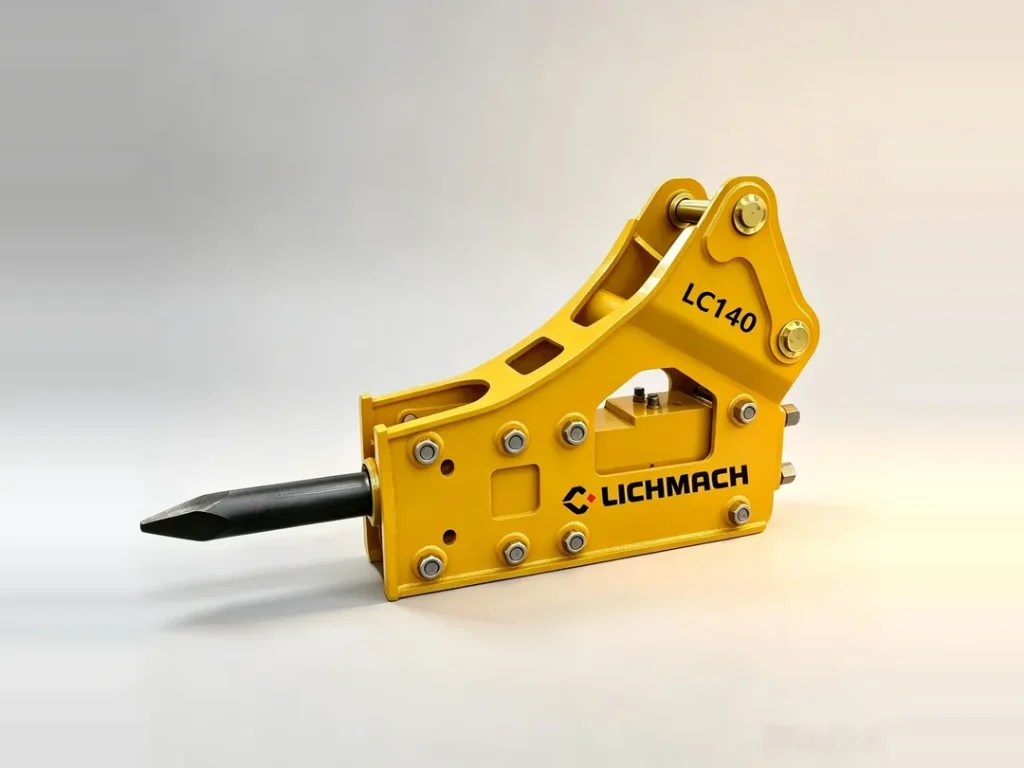
Hydraulic breaker flow rate is the oil volume the breaker needs each minute, and working pressure is the force behind that oil. Both have to sit inside the model’s window, or the breaker runs slowly, overheats or wears early. This chart gives the hydraulic breaker flow rate and pressure of 14 LICH models in metric and US units, with our calculation of the hydraulic power each one draws.
Hydraulic breaker flow rate and pressure chart
| Model | Excavator class | Oil flow | Oil flow (US) | Working pressure | Working pressure (US) | Hydraulic power at top of window |
|---|---|---|---|---|---|---|
| LC-40 | 1–1.5 t | 15–30 L/min | 4–8 GPM | 90–120 bar | 1,310–1,740 psi | 6 kW |
| LC-45 | 1.5–2 t | 20–40 L/min | 5–11 GPM | 90–120 bar | 1,310–1,740 psi | 8 kW |
| LC-53 | 3–5 t | 20–50 L/min | 5–13 GPM | 90–130 bar | 1,310–1,890 psi | 10.8 kW |
| LC-68 | 6 t | 40–60 L/min | 11–16 GPM | 90–130 bar | 1,310–1,890 psi | 13 kW |
| LC-75 | 7 t | 50–90 L/min | 13–24 GPM | 120–150 bar | 1,740–2,180 psi | 22.5 kW |
| LC-100 | 12 t | 80–110 L/min | 21–29 GPM | 150–180 bar | 2,180–2,610 psi | 33 kW |
| LC-135 | 20–25 t | 100–150 L/min | 26–40 GPM | 160–180 bar | 2,320–2,610 psi | 45 kW |
| LC-140 | 20–25 t | 120–180 L/min | 32–48 GPM | 160–220 bar | 2,320–3,190 psi | 66 kW |
| LC-150 | 25–30 t | 130–190 L/min | 34–50 GPM | 170–190 bar | 2,470–2,760 psi | 60.2 kW |
| LC-155 | 25–30 t | 180–240 L/min | 48–63 GPM | 180–230 bar | 2,610–3,340 psi | 92 kW |
| LC-165 | 30–36 t | 190–260 L/min | 50–69 GPM | 200–240 bar | 2,900–3,480 psi | 104 kW |
| LC-175 | 36–40 t | 200–250 L/min | 53–66 GPM | 210–240 bar | 3,050–3,480 psi | 100 kW |
| LC-195 | 42–55 t | 250–320 L/min | 66–85 GPM | 260–300 bar | 3,770–4,350 psi | 160 kW |
| LC-200 | 45–55 t | 260–340 L/min | 69–90 GPM | 260–300 bar | 3,770–4,350 psi | 170 kW |
Figures from the LICH model specifications, read on 6 November 2026. US units are rounded conversions. Hydraulic power is our calculation: litres per minute × bar ÷ 600, at the top of each window. Flow and pressure for the LC-35, LC-180, LC-200F and LC-230 are confirmed per order.
What the chart shows
- The power range is wide. From 6 kW on the LC-40 to 170 kW on the LC-200, about 28 times as much. So a circuit reading quickly rules out most sizes.
- Small machines need more oil per tonne. At the top of each window, the LC-40 takes about 20 L/min per tonne of its largest listed carrier, the LC-53 about 10, and the LC-135 and LC-200 about 6. A rule of thumb from a big machine will undersize the hydraulic breaker flow rate on a small one.
- Windows overlap. A circuit giving 105 L/min at 170 bar sits inside both the LC-100 and the LC-135. Flow narrows the choice, then excavator weight and the job decide it.
- Bigger is not always more oil. The LC-165 tops out at 260 L/min and the larger LC-175 at 250 L/min, with the same top pressure of 240 bar.
What happens outside the window
- Flow rate too low: the piston cycles slowly, so the blow rate drops and the work takes longer.
- Flow rate too high: the breaker runs too fast and the oil heats up, which wears seals and the piston. Limit the flow to the top of the window.
- Pressure too low: the breaker can stall or start unreliably, and the blows lose energy.
- Relief pressure set wrongly: set too low, the relief valve opens during work and turns power into heat. Set too high, it stops protecting the breaker.
Oil temperature is a useful early warning. If the oil runs hotter with the breaker than with the bucket, check the hydraulic breaker flow rate and relief setting first. Our troubleshooting guide covers the other causes.
How to find your excavator’s numbers
- Check the manual. Look for the auxiliary or breaker circuit, not the main pump figure. Pump flow is often much higher than what reaches the breaker line.
- Ask the dealer. Give the full model and serial number, because the same model can leave the factory with different circuits.
- Measure it. A hydraulic technician can fit a flow meter and pressure gauge at the breaker line and record flow against pressure with the engine at working speed.
- Write down the relief setting. Send it with the flow reading, so the match can be checked in full.
Pressure and flow adjustments belong with a qualified hydraulic technician, using the excavator maker’s procedure. The installation guide lists the checks at first start-up.
Convert the units yourself
- L/min × 0.264 = US gallons per minute (GPM).
- bar × 14.5 = psi.
- L/min × bar ÷ 600 = hydraulic power in kW.
Example: an excavator circuit of 120 L/min at 170 bar is about 32 GPM at 2,470 psi and draws 34 kW. It sits inside the LC-135 window of 100–150 L/min at 160–180 bar.
Questions about hydraulic breaker flow rate
What flow rate does a hydraulic breaker need?
It depends on the size: from 15–30 L/min on the LC-40 to 260–340 L/min on the LC-200. Read your model in the chart above.
What pressure does a hydraulic breaker run at?
LICH working pressures run from 90 bar on the smallest models to 300 bar on the largest.
Can I use a breaker if my flow is above the window?
Only with the flow limited to the window, or by choosing the size whose window fits. See the matching guide.
Does nitrogen pressure change the flow rate?
No. Nitrogen in the back head affects the blow, while oil flow sets the speed. See nitrogen pressure.
Send us your excavator model with the flow and relief readings at the breaker line. We will check them against the hydraulic breaker flow rate of the LICH range, recommend the size and quote it with the bracket and hoses.
Keep Comparing
Compare more breaker models and buyer guides related to this topic.


