
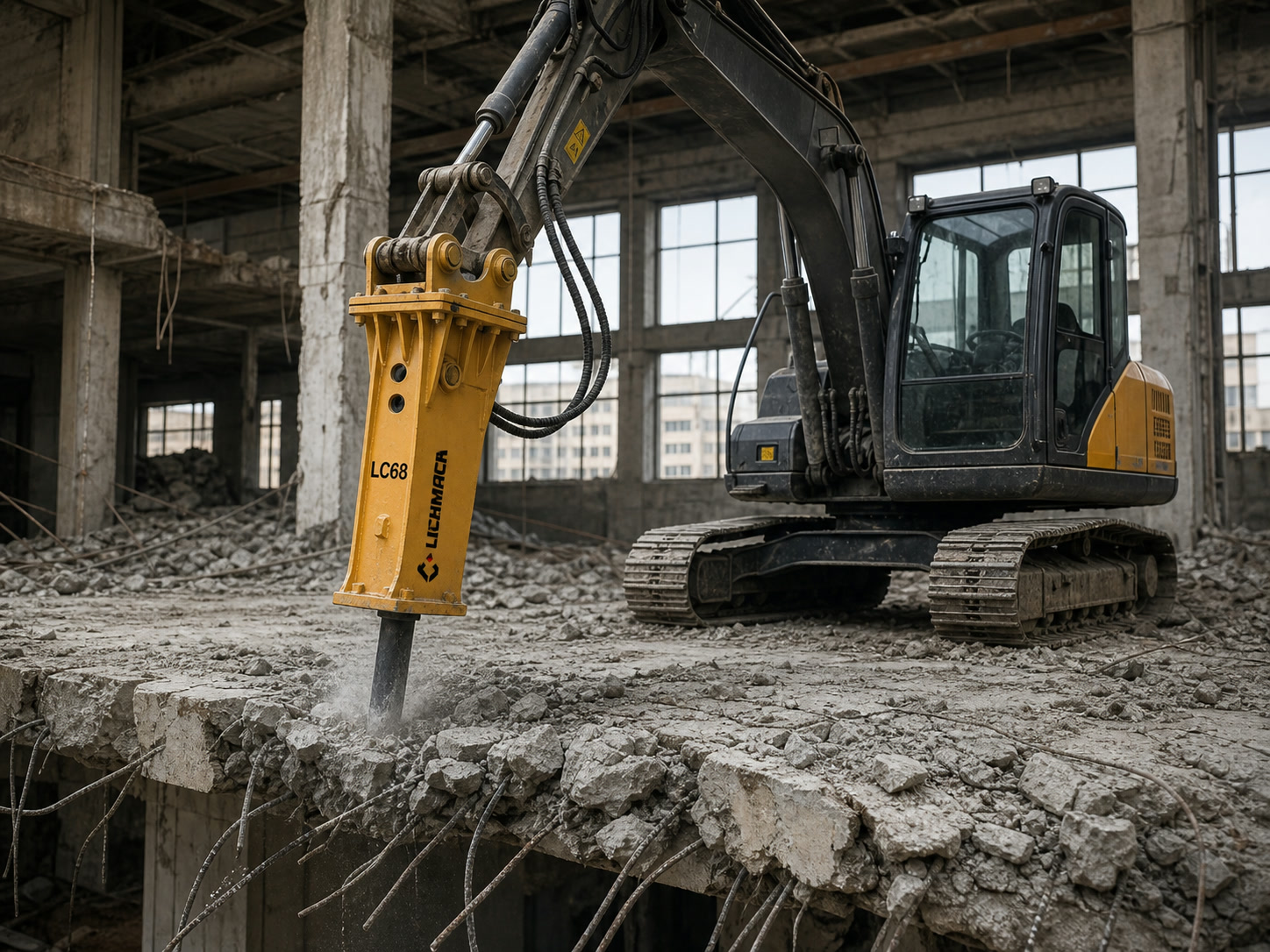
Hydraulic Concrete Breaker Guide
Match a hydraulic concrete breaker to the carrier, concrete condition, reinforcement, access, housing, tool and working method before quotation.
Use this page to match a hydraulic concrete breaker by carrier model, oil flow, pressure, concrete condition, reinforcement, access, housing, tool and working method.
Concrete is not one condition
A thin slab, reinforced wall, foundation, bridge deck and oversized concrete block create different access, tool and duty requirements.
Carrier data sets the usable range
Operating weight narrows the range, while oil flow, working pressure, relief setting and mounting information determine whether a proposed breaker can be checked.
Body and tool solve different problems
Housing affects access, service and noise discussion; the chisel shape affects how impact is introduced into the material. Neither replaces correct model matching.
Method protects the equipment
Keep the tool supported and aligned, work progressively from an edge or fracture path and stop when the tool, carrier or breaker shows abnormal behavior.
Describe the Concrete Before Selecting
Useful jobsite evidence is more specific than the phrase concrete demolition.
Slab and pavement
Record thickness, reinforcement, base condition, available edge, required removal size and whether the carrier can work from above.
Wall and structure
Record wall thickness, reinforcement, working height, surrounding structure, falling-material control and any indoor or urban restrictions.
Foundation and mass concrete
Provide dimensions, exposed edges, embedments, access, removal sequence and whether continuous heavy duty is expected.
Reinforced or mixed material
Send photos showing steel and mixed layers. The breaker opens and fractures material; cutting and separation may require other tools and a planned sequence.
Hydraulic Concrete Breaker Selection Route
Use the same documented checks before opening a price discussion.
Identify the carrier
Send full carrier model, operating weight and any regional hydraulic-package information rather than only a broad tonnage class.
Confirm the hydraulic circuit
Provide auxiliary oil-flow range, working pressure and relief information. A proposed breaker must operate within the actual circuit range.
Describe the concrete and access
Send material photos, dimensions, reinforcement, access direction, noise limits and expected daily duty.
Choose housing and tool route
Discuss open or enclosed housing, service access and chisel shape after the carrier and material are known.
Confirm mounting and supply
Check bracket or coupler dimensions, hoses, fittings, starter parts, quantity, packing and destination in the written quotation.
Concrete-Breaking Working Checks
Operator training and the exact manual remain controlling; these checks help identify unsafe or inefficient setup.
What a Hydraulic Concrete Breaker Quote Should Record
A useful quotation identifies both the proposed supply and the information used to select it.
Carrier basis
Full carrier model, operating weight, oil-flow range, working pressure and the mounting record used for the proposal.
Job basis
Concrete type, dimensions, reinforcement, access, restrictions and expected duty supplied by the buyer.
Breaker supply
Proposed model, body structure, tool, bracket or coupler scope, hoses, fittings and starter parts.
Commercial boundary
Quantity, destination, packing, shipping term and any open technical checks that still require written confirmation.
Frequently Asked Questions
Plain answers before the first quote.
It is a carrier-mounted hydraulic breaker used to introduce repeated impacts through a working tool into concrete. The correct model still depends on carrier hydraulics, concrete condition, duty, access and mounting.
No. Tonnage narrows the range, but oil flow, pressure, mounting, material, access and expected duty must also be checked.
There is no universal tool. Wedge, cone or pyramid, flat or blunt and wider tools serve different fracture, splitting and surface tasks. Confirm the material and breaker model before ordering.
An enclosed or silent housing can be discussed for noise-sensitive work, but local requirements, carrier match, service access and final model availability still need confirmation.
No universal output is published. Concrete strength, reinforcement, dimensions, access, carrier hydraulics, tool condition, operator method and site organization all affect production.
Send carrier model and weight, oil flow, pressure, mounting photos, concrete dimensions and reinforcement, access restrictions, expected duty, quantity and destination.
Continue Through the Hydraulic Breaker Guides
Use the next topic that matches your selection, operation, parts or support question.
Hydraulic breaker guide hub
Continue to carrier selection, parts, maintenance and troubleshooting topics.
View detailsChisel and breaker bits
Compare tool shapes and prepare a model-and-dimension parts record.
View detailsHow a breaker works
Understand the hydraulic and mechanical path behind repeated tool impacts.
View detailsReady to check the right breaker?
Send carrier model, hydraulic data, quantity and destination port. LICHI can reply with a checked model path.
