
Hydraulic Breaker for Quarry Work: Sizing, Tools and Upkeep
How to choose a hydraulic breaker for quarry work: primary vs secondary breaking, large LC models for 36–80 t excavators, tools for hard rock and daily upkeep.
All buyer guides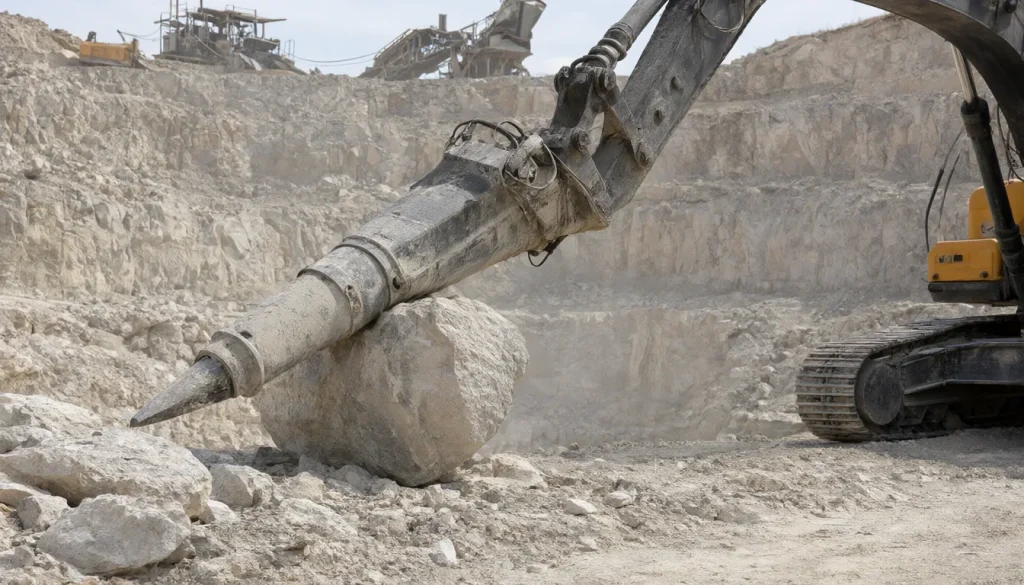
A hydraulic breaker for quarry work has a harder life than almost any other attachment: long shifts, hard rock, oversize boulders and dust. In a quarry the breaker does two jobs. Primary breaking takes rock out of the face or the floor where blasting is limited or not allowed; secondary breaking reduces oversize boulders so they fit the crusher. This guide covers how to size a quarry breaker, which LICH hydraulic breaker models suit 36–80 t excavators, and how to keep one working.
The large LICH models
| Model | Excavator class | Breaker weight | Chisel | Oil flow | Working pressure | Impact rate | Impact energy |
|---|---|---|---|---|---|---|---|
| LC-175 | 36–40 t | 3,757 kg | 175 mm | 200–250 L/min | 210–240 bar | 120–200 bpm | 15,500 J |
| LC-195 | 42–55 t | 5,400 kg | 195 mm | 250–320 L/min | 260–300 bar | 100–140 bpm | 25,490 J |
| LC-200 | 45–55 t | 6,388 kg | 200 mm | 260–340 L/min | 260–300 bar | 100–140 bpm | 29,700 J |
| LC-200F | 45–55 t | Full figures on request; tower and triangular bodies for quarrying and hard-rock work | |||||
| LC-230 | 60–80 t | Full figures on request; for open-pit mining and heavy rock breaking | |||||
From the LICH model specifications, read on 14 October 2026.
Primary or secondary breaking?
Primary breaking means working the rock in place: opening a face, lowering a quarry floor or removing rock where blasting is restricted near houses, roads or other structures. It calls for the most energy per blow the carrier can run, so a hydraulic breaker for quarry primary work is usually the largest model the excavator’s circuit supports: the LC-195 or LC-200 on a 45–55 t machine, the LC-230 on a 60–80 t machine.
Secondary breaking means reducing oversize boulders after the blast, at the face or at the crusher. The blocks are already loose, so a slightly smaller, faster breaker cycles through them quickly. The LC-175 on a 36–40 t excavator, or the 25–36 t models in our hydraulic breaker for 30 ton excavator guide, cover most secondary work.
Sizing a hydraulic breaker for quarry work
- Match the circuit first. The LC-195 and LC-200 need 250–340 L/min at 260–300 bar. Check the excavator’s breaker-circuit output before choosing; a large breaker on a small circuit runs slowly and heats the oil.
- Respect the boom. At 5,400 kg and 6,388 kg, the large models suit 42–55 t carriers working close in on stable ground.
- Use energy for hard rock. Moving from the LC-175 to the LC-200 almost doubles impact energy (15,500 J to 29,700 J) for granite, basalt and other hard stone.
- Pick the body for the site. A tower (top-mounted) body suits long shifts at a face; a triangular side-mounted body is quick to service; a silent box body helps when the quarry has neighbours. The LC-200 also comes as a concentric body at 5,900 kg.
Tools for quarry rock
A blunt tool spreads the blow over a larger area and suits boulders and oversize blocks in secondary breaking; a moil or pyramid point suits general rock; a wedge chisel splits layered rock and cuts trenches. Shapes, steel grades and wear patterns are covered on the hydraulic breaker bits page. With a hydraulic breaker for quarry duty, keep at least two spare tools on site, since tool changes are the most common stoppage.
Keeping a hydraulic breaker for quarry duty working
- Grease on the schedule in the model manual, with the tool pressed into the bushing, or fit an automatic grease system. See the hydraulic breaker grease guide.
- Never blank fire. Stop striking when the rock breaks and reposition, so the piston does not hit an unsupported tool.
- Do not pry with the tool. Levering boulders with the chisel bends it and wears the bushings unevenly.
- Measure bushing wear at every tool change and replace bushings before the gap grows. The hydraulic breaker parts page lists the guides for each wear part.
- Check nitrogen pressure on a schedule, because a low charge cuts impact energy. Follow the nitrogen pressure guide.
Output per hour
Quarry output depends on rock hardness, block size, operator skill and how the crusher is fed, so it is measured on site rather than taken from a catalogue. Our production rates article explains how to record cycle times and tonnage so you can compare two breakers on the same face.
Send us your excavator model and breaker-circuit output, the rock type and whether you need primary or secondary breaking. We will recommend the hydraulic breaker for your quarry and quote it with spare tools, bushings and a seal kit.
Related reading: hydraulic breaker impact energy, and why the largest models suit hard rock.
Related reading: the 40 ton excavator breaker guide compares the LC-165, LC-175 and LC-195 by flow, pressure and energy.
Keep Comparing
Compare more breaker models and buyer guides related to this topic.


