
Hydraulic Breaker for Road Construction: Jobs and Model Sizes
Choosing a hydraulic breaker for road construction: pavement removal, trenches, rock cuts and oversize rock, with LICH models by excavator class.
All buyer guides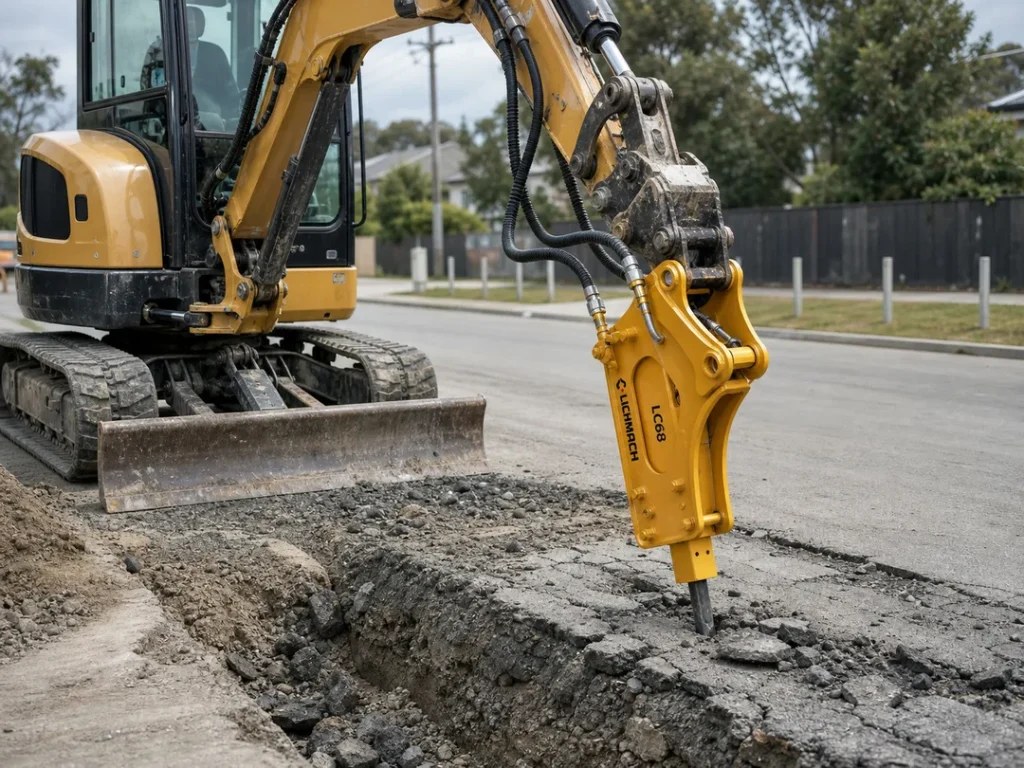
A hydraulic breaker for road construction does four jobs: removing old pavement, opening trenches for drains and cables, cutting rock where the road runs through a hillside, and reducing oversize rock for fill and base. They call for different sizes. Pavement wants fast, light blows, and a rock cut wants heavy ones. This guide matches each job to LICH models by excavator class, impact rate and impact energy.
Four road jobs and the breaker each needs
| Job | Material | What matters | Excavator class | LICH models |
|---|---|---|---|---|
| Pavement and slab removal | Asphalt, plain and reinforced concrete | A high impact rate | 6–12 t | LC-68, LC-75, LC-100 |
| Trenches for drainage and utilities | Mixed ground, soft to medium rock | A steady rate and a slim tool | 7–25 t | LC-75, LC-100, LC-135 |
| Rock cuts and benches | Medium to hard rock in place | Energy per blow | 25–40 t | LC-155, LC-165, LC-175 |
| Oversize rock for fill and base | Boulders from blasting or digging | Energy and tool diameter | 20–36 t | LC-140, LC-150, LC-165 |
Model figures for a hydraulic breaker for road construction
| Model | Excavator class | Chisel diameter | Impact rate | Impact energy | Oil flow |
|---|---|---|---|---|---|
| LC-68 | 6 t | 68 mm | 500–990 BPM | 1,016 J | 40–60 L/min |
| LC-75 | 7 t | 75 mm | 450–980 BPM | 1,835 J | 50–90 L/min |
| LC-100 | 12 t | 100 mm | 350–700 BPM | 3,102 J | 80–110 L/min |
| LC-135 | 20–25 t | 135 mm | 350–500 BPM | 6,190 J | 100–150 L/min |
| LC-140 | 20–25 t | 140 mm | 350–450 BPM | 6,485 J | 120–180 L/min |
| LC-150 | 25–30 t | 150 mm | 280–400 BPM | 9,380 J | 130–190 L/min |
| LC-155 | 25–30 t | 155 mm | 200–300 BPM | 10,930 J | 180–240 L/min |
| LC-165 | 30–36 t | 165 mm | 150–300 BPM | 13,200 J | 190–260 L/min |
| LC-175 | 36–40 t | 175 mm | 120–200 BPM | 15,500 J | 200–250 L/min |
Figures from the LICH model specifications, read on 13 November 2026.
Pavement and slab removal
Asphalt and thin concrete break under many light blows. On a 7 t excavator the LC-75 strikes up to 980 times a minute, about 16 blows a second, with 1,835 J in each. On a 12 t machine the LC-100 gives 3,102 J, 69% more per blow, at 350–700 BPM. For thick or heavily reinforced slabs, a 20–25 t excavator with the LC-135 doubles the energy of the LC-100, to 6,190 J.
On a backhoe loader, the breaker takes the place of the rear bucket, and the backhoe hydraulic breaker guide covers the fit. For the carrier itself, LICH lists backhoe loaders on lichmach.com.
Trenches for drainage and utilities
A trench in rock is opened by a row of break points along the line, then cleaned out with the bucket. The tool diameter sets how narrow that row can be: 75 mm on the LC-75, 100 mm on the LC-100 and 135 mm on the LC-135. A moil point concentrates the blow for starting in solid rock. In streets and near housing, the box body keeps noise down; all nine models in the table are offered as a silent hydraulic breaker.
Rock cuts and oversize rock
Where the alignment cuts through rock, energy per blow decides the output. The LC-165 on a 30–36 t excavator delivers 13,200 J, a little more than twice the LC-135, and the LC-175 on a 36–40 t machine delivers 15,500 J. The rate falls as energy rises: 150–300 BPM on the LC-165 against 350–500 BPM on the LC-135.
The same machines break oversize boulders so they can be loaded or used as fill. Quarry-scale work on 45 t and larger excavators is covered in the quarry guide.
Choosing one hydraulic breaker for road construction
- Start from the excavator. The class column shows which models your machine can carry. The weight chart gives each breaker’s share of the excavator’s weight.
- Name the main job. Mostly pavement and trenches: favour the higher impact rate. Mostly rock: favour energy.
- Check the oil flow. The last column must sit inside what the auxiliary circuit delivers.
- Pick the body. Box type for streets and night work, side or top type for open sites.
For one 20–25 t excavator on mixed work, compare the LC-135 and LC-140. The LC-135 runs faster, up to 500 BPM. The LC-140 hits harder, 6,485 J, and takes more oil, 120–180 L/min.
Questions about a hydraulic breaker for road construction
Which hydraulic breaker is best for breaking asphalt?
A small, fast one. The LC-68 and LC-75 on 6–7 t carriers reach 980–990 BPM.
What size hydraulic breaker for road construction with a 20 ton excavator?
The LC-135 or LC-140. Both are listed for 20–25 t excavators, with 6,190 J and 6,485 J.
Can one breaker handle both pavement and rock?
Within one excavator class, yes. On a 20–25 t machine the LC-135 covers reinforced slabs and medium rock. Hard rock in a deep cut calls for a 30 t class excavator and the LC-165.
What information is needed for a quotation?
The excavator brand and model, the auxiliary oil flow and pressure, the main material, and the destination port.
Keep Comparing
Compare more breaker models and buyer guides related to this topic.


