
Hydraulic Breaker Price Guide: Compare Export Quotes
Understand hydraulic breaker price factors, normalize export quote scope and compare model, bracket, parts, packing and freight on equal terms.
All buyer guides
Why a Hydraulic Breaker Price Is Not One Universal Number
A hydraulic breaker price only becomes comparable after the technical configuration and delivery basis are fixed. Two quotations can use the same general product name while covering different chisel diameters, body structures, brackets, hoses, tools, spare parts, packing and trade terms. The lower number is not automatically the lower-cost order.
This guide explains the evidence that changes an export price and how to compare quotations without treating an incomplete offer as a finished landed cost. It does not publish a fixed price list because steel cost, exchange rates, freight, order quantity and confirmed configuration can change.
The Seven Layers Behind a Breaker Quotation
| Price layer | What changes it | Evidence to request |
|---|---|---|
| Breaker class | Chisel diameter, operating weight and hydraulic range | Public LC model and technical selection record |
| Body structure | Triangular, tower, silent or concentric construction | Body type written on the quotation |
| Mounting | Direct-pin bracket, quick-coupler interface and dimensions | Approved bracket or coupler drawing |
| Hydraulic connections | Hose length, diameter, fittings and included quantity | Hose and fitting schedule |
| Tools and parts | Chisel quantity, tool shape and model-matched spare parts | Separate line items with quantities |
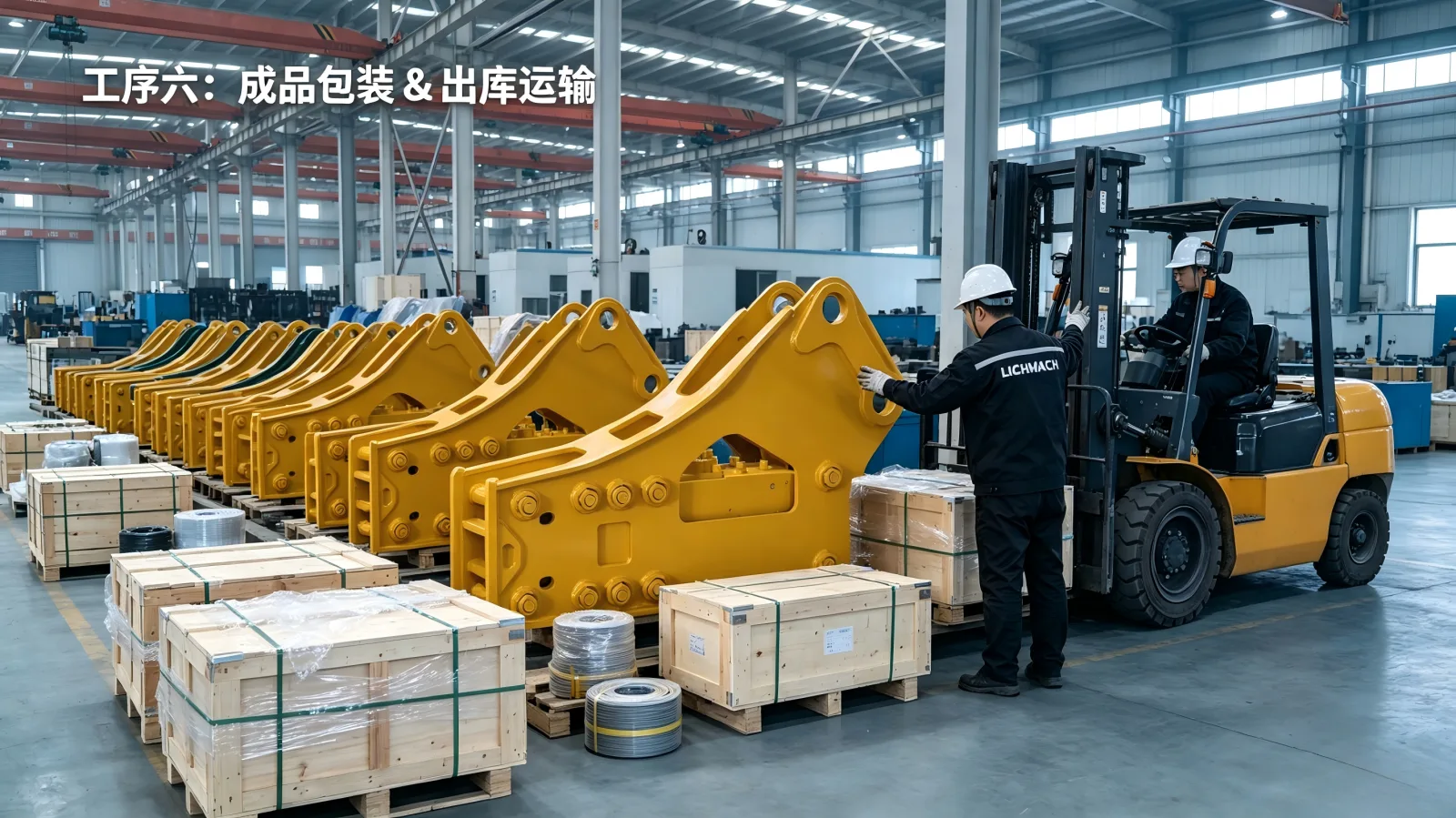
| OEM and packing | Color, logo, nameplate, labels, case or pallet | Approved artwork and packing basis |
| Delivery basis | Named place or port, inland transport, freight and insurance | Incoterms® rule, named point and validity date |
If one quotation includes several of these layers and another excludes them, the total numbers describe different purchases. Normalize the scope first, then compare.
1. Breaker Class Starts With Chisel Diameter, Not a Guess
LICHI public model names follow the chisel diameter. LC-68 identifies the 68 mm class, LC-140 the 140 mm class and LC-200 the 200 mm class. This makes the diameter visible on quotations and parts requests, but it is not a complete fitment approval.
The carrier’s auxiliary oil flow, working pressure, relief setting, complete attachment limit and mounting interface still need to match the proposed breaker. A price obtained from carrier tonnage alone is a preliminary reference. Use the breaker-to-excavator matching guide to prepare the technical inputs before asking for a final price.
2. Body Type Can Change the Scope
Triangular, tower, silent and concentric breakers do not have identical outer structures. Housing plates, brackets, fasteners, protection and access differ. A buyer who asks only for “one 140 mm breaker” may receive quotations for different body configurations.
State the body type next to the LC model. If the worksite has a noise restriction, limited access or a specific mounting requirement, write that condition into the request instead of choosing from appearance. The LICHI breaker range shows the available body families.
3. The Bracket Is a Machine-Specific Cost
A breaker body can be suitable for the hydraulic circuit while the supplied bracket does not fit the carrier. Direct-pin dimensions, quick-coupler geometry, pin diameter, pin-center distance and inside width must be confirmed before fabrication.
Do not compare a bare-breaker price with a quotation that includes a custom bracket. Ask both suppliers to state whether the bracket is included, which carrier or coupler it is based on, and whether a drawing approval is required. A photo of the excavator is useful context but not an approved dimension record.
4. Hoses, Fittings and Working Tools Need Separate Lines
“Standard accessories included” is too vague for an export comparison. The quotation should list hoses, fittings, chisel quantity, tool shape, gas charging or maintenance items, toolbox items and every requested spare part.
Hoses must be identified by the hydraulic circuit, dimensions and both end fittings. Chisels must match the public LC model and the intended material. Use the hose identification guide and chisel selection guide when preparing those lines.
5. First-Order Spare Parts Change Purchase Cost but Reduce Later Friction
A dealer, fleet and single-machine end user do not need the same spare-parts quantity. The correct first order depends on breaker count, duty, service access, shipping time and the parts already available locally.
Keep the breaker price and spare-parts bundle as separate subtotals. This exposes the actual equipment price and lets the buyer adjust inventory without changing the matched breaker. The first-order spare-parts guide provides a model-specific request format.
6. OEM Work Is More Than Adding a Logo
OEM scope can include paint color, logo files, decal positions, nameplate fields, document language, carton or case labels and packing marks. Each item needs an approval path. A quotation that says “OEM available” does not prove all of those items are included.
Ask for a written list of OEM deliverables and identify which approval starts the production lead time. If the artwork or nameplate data changes after production release, request a revised document and review the price and schedule impact.
7. EXW, FOB and CIF Prices Are Not Interchangeable
A product price at the factory and a price that includes carriage to a named port cover different obligations. The trade term must be paired with a named place or port and the version of the Incoterms® rules being used. Freight validity also matters because the route and rate can change.
Do not treat a CIF number as a final delivered cost. Import clearance, duty, destination fees, inland delivery and local taxes may remain outside the quotation. Confirm those items with the buyer’s forwarder or trade adviser.
How to Compare Two Hydraulic Breaker Prices
- Freeze the technical match: use the same carrier, hydraulic inputs, LC model, body type and chisel diameter.
- Freeze the mounting scope: use the same bracket or coupler basis, hoses and fittings.
- Freeze accessories: list the same tools, quantities and spare-parts package.
- Freeze OEM and packing: compare the same color, branding, labels and packing method.
- Freeze the delivery point: compare the same named place or port, currency and trade term.
- Check validity: note the price date, freight validity and conditions that start lead time.
- Record exclusions: identify duties, destination charges, installation and other costs not included.
A Simple Price-Normalization Worksheet
| Comparison field | Supplier A | Supplier B | Decision |
|---|---|---|---|
| LC model / chisel diameter | Record exact value | Record exact value | Must match |
| Body type | Record exact type | Record exact type | Must match |
| Bracket / coupler | Included or excluded | Included or excluded | Normalize |
| Hoses, fittings and chisels | List quantities | List quantities | Normalize |
| Spare parts | Separate subtotal | Separate subtotal | Compare like for like |
| OEM and packing | Approved scope | Approved scope | Normalize |
| Trade term and named point | Exact wording | Exact wording | Must match |
| Validity and lead-time basis | Record conditions | Record conditions | Review risk |
Red Flags in a Very Low Price
- The model is selected from an excavator marketing label without hydraulic data.
- The body type or chisel diameter is missing.
- The bracket basis is not stated or still depends on unconfirmed dimensions.
- Hoses, fittings, tools and spare parts are hidden under “standard accessories.”
- OEM work is promised but no deliverable list or approval record exists.
- The trade term has no named place or port.
- Freight has no route, date or validity period.
- Warranty wording does not separate manufacturing defects from normal wear and operating damage.
A low price can be legitimate, but only after these fields are equal. Ask for a revised quotation rather than filling gaps with assumptions.
Price Changes That Require a New Revision
A quotation should be revised when the carrier, coupler, breaker body, chisel quantity, spare-parts scope, OEM file, packing method, delivery point or trade term changes. The change may affect several lines at once. A different coupler can change the bracket and hose arrangement; a different destination can change packing and freight; a different body can change the product and service-parts scope.
Do not approve a change only in a messaging thread. Ask the supplier to mark the new revision date, identify the changed lines and keep the previous version as superseded. The final proforma invoice, technical approval and packing instruction should all point to the same configuration.
How Order Quantity Affects the Comparison
Quantity can change packing efficiency, inland transport, document workload and the way spare parts are stocked. It may also affect commercial pricing, but never assume a discount formula. Ask for the unit price, quantity, subtotal and quantity-specific inclusions in writing.
For mixed-model orders, compare each LC model as a separate line. Do not divide one total by the number of breakers when the shipment contains different diameter classes, brackets or accessories. Allocate common packing and freight separately if a true per-unit landed estimate is required.
Keep Price and Technical Approval Separate
A buyer can accept a commercial range while technical fields are still pending, but the document must say so. Use labels such as “budgetary,” “preliminary” or “pending carrier hydraulic confirmation.” Do not allow a price approval to release production when the bracket or model remains unapproved.
The safest release gate is a matched set: technical selection sheet, bracket or coupler drawing, accessory list, OEM approval and commercial quotation. Production starts only after the responsible contacts approve the same revision.
Information to Send for a Firm Export Quote
- carrier brand, full model, operating weight and nameplate photo;
- auxiliary oil flow, working pressure and relief setting;
- coupler type or bracket dimensions and connection photos;
- work material, application, site conditions and preferred body type;
- quantity, chisel shapes, spare parts and OEM requirements;
- destination country, named port or place and requested trade term;
- target order date and requested delivery date.
Ask the supplier to return missing fields as a visible exception list. If a number is estimated, the quotation should label the assumption and identify what evidence will convert it to a firm value. This is more reliable than a fast quote that silently fills gaps.
Use the complete hydraulic breaker export quote checklist to copy these fields into one request.
Reference Boundary
Manufacturer technical brochures list carrier class, tool diameter, oil flow and operating pressure separately, supporting the need to confirm configuration before price. The International Chamber of Commerce explains that an Incoterms® rule should be selected for the actual transaction and named delivery point. These sources define the comparison method; the final LICHI technical data and commercial quotation control the order.
Frequently Asked Questions
How much does a hydraulic breaker cost?
The price depends on the confirmed breaker class, body type, mounting, accessories, spare parts, OEM work, packing and delivery basis. Request a written configuration instead of using one universal number.
Can I compare prices by chisel diameter only?
No. Diameter helps identify the LC class, but body structure, hydraulic match, mounting and included scope must also be equal.
Does a quoted price include the bracket and hoses?
Only if they are listed. Ask for the bracket basis, hoses, fittings and quantities as separate lines.
Is CIF the final delivered cost?
Not necessarily. Destination charges, duty, tax, customs clearance and inland delivery may remain outside the quotation.
Why does the supplier need my excavator hydraulic data before pricing?
It prevents the quotation from being based on a breaker that does not match the carrier’s flow, pressure or mounting requirements.
Keep Comparing
Compare more breaker models and buyer guides related to this topic.


