
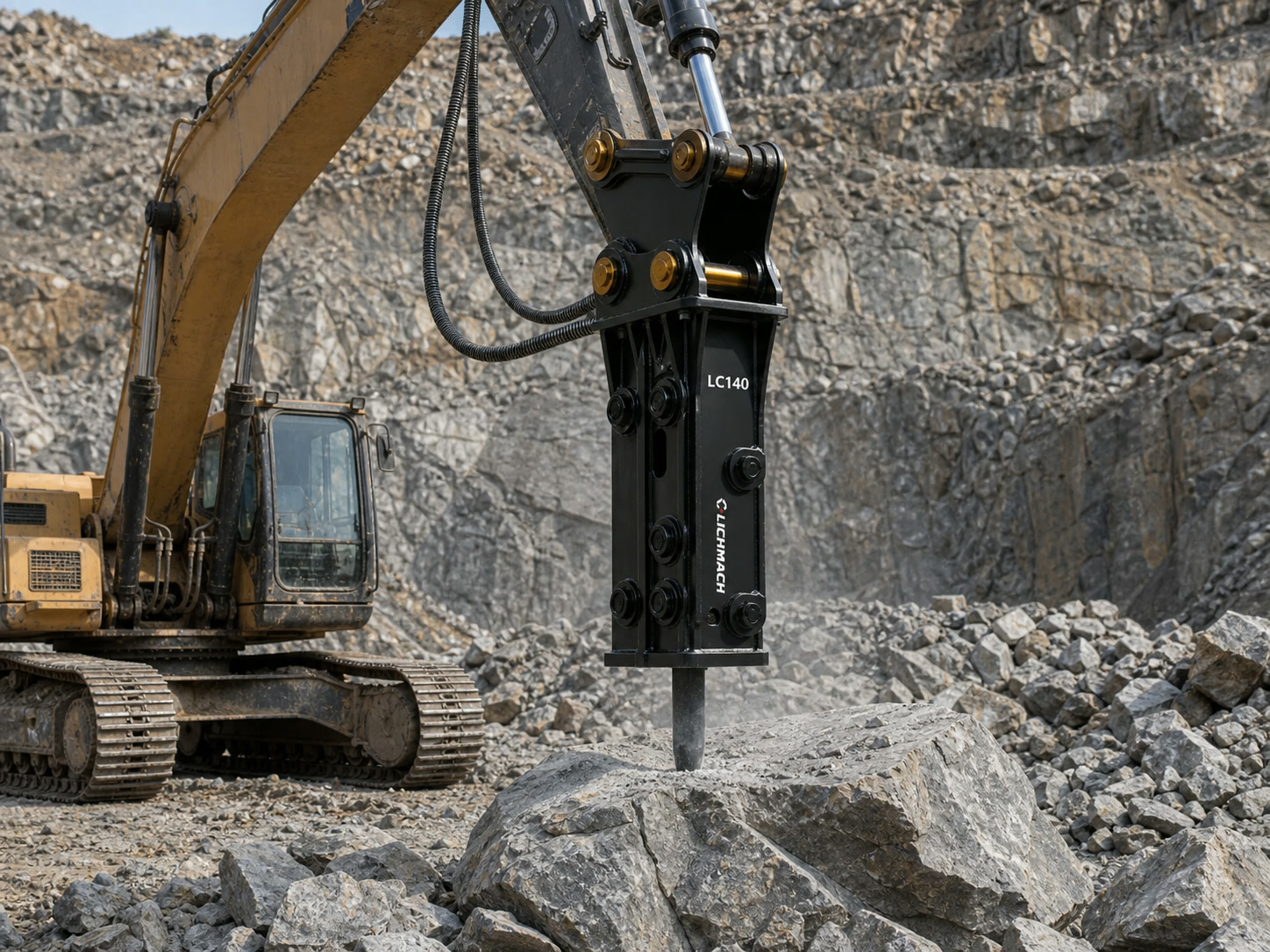
Hydraulic Rock Breakers for Excavators
Select a hydraulic rock breaker by carrier weight, flow, pressure, rock condition, production objective, tool and mounting—not by impact claims alone.
Use this page to select a hydraulic rock breaker by excavator weight, auxiliary flow, pressure, rock condition, duty, tool, mounting, spare-parts plan and destination.
Rock work is not one duty
Primary excavation, secondary boulder reduction, trench rock and occasional demolition place different demands on a hydraulic rock breaker and carrier.
Carrier data controls the range
Operating weight narrows the model list. Oil flow, working pressure and mounting information determine whether the proposed breaker can be checked for that excavator.
Material evidence improves selection
Rock photos, fracture pattern, hardness information when known and the required production objective are more useful than describing every site only as hard rock.
Claims stay source-bounded
LICHI does not publish unsupported tonnes-per-hour or universal service-life promises. The page separates confirmed product data from jobsite information still required.
Define the Job for Your Hydraulic Rock Breaker
The selection starts with what must be broken and how the excavator will work, not with a single impact-energy number.
Primary rock excavation
Describe whether the breaker will open unblasted rock, remove a foundation or work a confined cut. Include rock photos, access, bench geometry and expected duty cycle.
Secondary breaking
Record boulder size, frequency and whether the task follows blasting or excavation. Oversize reduction can require a different tool and working pattern from primary excavation.
Quarry and mine support
State whether the breaker is for continuous production, occasional blockage, scaling or stockpile boulders. Carrier availability and maintenance planning should be included.
Trench and foundation rock
Provide trench width, depth, access and surrounding structures. Working angle, hose routing and body clearance can limit an otherwise suitable model.
Hydraulic Rock Breaker Matching Route
Use the same documented route for a compact trench job or a heavy quarry inquiry.
Identify the excavator
Send carrier brand, full model and operating weight. If the machine has several regional hydraulic packages, include the nameplate or manual page used.
Record flow and pressure
Provide auxiliary oil flow, working pressure and relief information when available. The proposed breaker range must overlap the actual carrier circuit.
Describe rock and duty
Send photos and state the task, expected daily use and whether the work is primary excavation, secondary reduction, quarry support or trenching.
Choose body and tool route
Compare service access, housing, working direction and tool shape after the carrier and material are known. Body type is not a substitute for model matching.
Confirm mounting and supply
Check bracket or coupler dimensions, hoses, fittings, starter parts, quantity, packing and destination. Record each item in the written quotation.
Compare Hydraulic Rock Breaker Body Types
The available body structures solve different access, service and housing requirements; final availability depends on the confirmed model.
Tower or top type
A tower route can be reviewed for vertical work, foundations, trenches and rock applications after the carrier range and hydraulic data are checked.
View detailsConcentric type
LICHI lists confirmed concentric models for non-blasting quarry extraction, urban rock foundation excavation and related applications within their recorded carrier classes.
View detailsSilent or box type
An enclosed housing can be discussed when noise, dust or urban-site conditions matter. Rock duty, model range and mounting still require confirmation.
View detailsApplication hub
Compare rock, demolition and road-work routes before choosing a breaker body or tool.
View detailsHydraulic Rock Breaker RFQ Checklist
Send a complete site and carrier record so the reply can separate confirmed data from open questions.
Frequently Asked Questions
Plain answers before the first quote.
It is an excavator attachment that uses the carrier hydraulic circuit to drive repeated piston impacts through a working tool. Model selection still depends on the carrier, material, duty and mounting record.
A breaker may be used across more than one material when the model, tool and carrier match are suitable, but concrete demolition and continuous hard-rock work should not be treated as identical duty.
There is no universal body answer. LICHI can compare tower and confirmed concentric routes after the excavator, hydraulic data, rock condition, duty cycle and service requirements are provided.
No universal output is published. Production depends on rock properties, fracture pattern, carrier hydraulics, operator method, tool condition, working angle and site organization.
Send clear photos, approximate boulder or bench dimensions, known hardness or geology if available, the required task, expected daily use and any access or noise restrictions.
Customer video shows a model 81 silent breaker working against a large rock. The LICHI source table maps that breaker to a 140 mm tool and 20–25 t carrier class; measured output and service-life data were not supplied.
Continue Through the Hydraulic Breaker Guides
Use the next topic that matches your selection, operation, parts or support question.
All hydraulic breaker guides
Move between application, working-principle, tool, pressure and troubleshooting topics.
View detailsConcrete breaker guide
Compare concrete condition, access, carrier data, housing and tool choice.
View detailsHow a breaker works
Understand how carrier oil flow, the control valve, piston and tool create impacts.
View detailsReady to check the right breaker?
Send carrier model, hydraulic data, quantity and destination port. LICHI can reply with a checked model path.
